
Auroville Granary
In Auroville’s early years, when most of the community was engaged in stewarding land, land-use patterns were mixed. Along with planting trees, people cultivated vegetables, fruits and grains. Over the years, as growing food was not easy, there was a marked emphasis on afforestation. And as farms were turned into forests, grains were the first to fall by the wayside. The grain production of Auroville decreased.
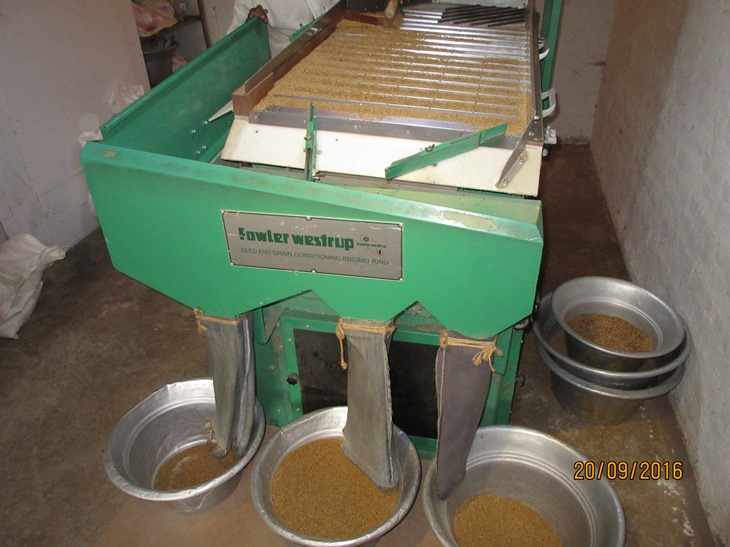
Of the 20-odd farms in Auroville today only a few grow grains anymore. New farms often grow some grains in the first few years but then abandon them. For, growing grains is financially very challenging, high-risk, and demands special management skills. Besides that, grain farming needs its own special layout and infrastructure for irrigation, storage, etc. Grains require processing and cleaning which calls for skilled-labor and machinery.
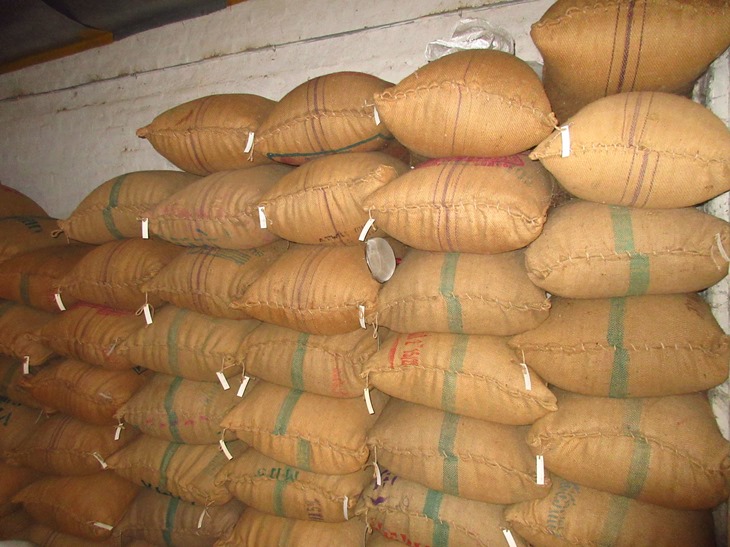
The year 2011 saw a decisive shift in the functioning of grain farming in Auroville. Annapurna Farm took on the additional task to function as a central granary where grains are dried, cleaned, stored and processed.
Since growing grains needs substantial financial input at the beginning of the growing season, Auroville created a crop loan fund within its internal financial organization so that a farmer has enough cash flow, in the form of a loan, to cultivate a crop. Once the crop is harvested, it goes straight to the Auroville granary at Annapurna, where the crop is dried, cleaned, assessed and stored. The crop is stored in Annapurna’s storerooms until there is a demand from the community. This can be as long as one year later, and then, as per the demand, the grain is processed at Annapurna. It is then transported for further distribution to the Foodlink facility located in the city centre of Auroville or direct to consumers in bulk.
To improve standards, the Auroville Grain Group was established. The participants meet once a month on a grain farm and discuss improvements in grain cultivation, review crop planning, determine prices, review crop loan applications, and track planting and harvesting.
Today these efforts are bearing fruits. As farmers have finances available at the right time through the crop loan system, crop yields are improving, and grain quality has become better because of improved drying, cleaning and storing facilities. Planning is more smooth because the grain group members meet regularly and the peer review helps all farmers to learn and improve their standards.
Our Rice
Annapurna started to grow rice in 1987 in a few small plots to gaze at crop development in a heavy clay cotton soil, with years of learning; mainly increasing the rain water harvest capacity [we harvest about 50,000 cubic meters of rain water each year to sustain the farm irrigation needs, that includes: Rice, dairy and orchards]. We increased the acreage, machine park, rice milling capacity and storage/drying space. Today we are growing around 20 acres (8 Ha) of paddy (rice) which is cultivated from end August to March starting just before the monsoon and harvesting after the rains are over. We sow in small batches to be able to spread the workload of field preparation, planting and weeding. Our rice is processed in small batches. Processing of a crop of paddy into rice happens from a few months to 1-2 years after harvest, depending on demand.
What is Paddy?
Paddy becomes rice after the removal of husk by de-husking. Therefore, rice is a part of paddy. Paddy is the rice grain with husk. The term paddy was derived from a Malay word with the meaning “rice in the straw or husk”. Generally, rice plant also is called paddy. This is a crop which belongs to the family Graminae. Botanical name of the paddy is Oryza sativa. It is a wetland crop, which extensively grows all over the world.
White Rice vs Brown Rice
White rice and brown rice differ in nutrients and preparation. While white rice is more popular, brown rice retains its bran and germ, making it more fibre-rich and nutritious. Brown rice is chewy but less versatile in certain dishes. It also takes longer to cook and has a shorter shelf life compared to parboiled white rice. Despite these drawbacks, health experts often recommend brown rice for its superior nutrient content.
Is it the same grain?
Raw, Boiled, Red and Complete rice.
“It’s all rice, but they are different varieties and differently processed; the complete (brown) is a rice we baptized “Annapurna” since we picked it out in the middle of another variety; it’s a kind of farmers selection. The red rice (which is at the same time complete) is Poovan samba, the parboiled and raw rice are various other variety rices.”
Are you doing the processing at the farm?
“Yes, we process as much as possible grains on the farm to make sure no adulteration takes place (food gets mostly polluted/adulterated during processing). We are handling a very diverse grain need in Auroville and work with small amounts. All this is difficult to get done anywhere else. Local organic farmers often come with a request to process their millet and indigenous paddy at Annapurna since they have nowhere else to go.”
How long can you stock rice and millet?
“Stocking millets in raw form (in the husk) is no problem. All millets can be stored for a year, and some like varagu (kodo millet) for many years. Paddy (is rice in husk) loss starts to increase substantially when it becomes older than one year. Sun-drying it regularly will help but this is not easy with large quantities of stock. Processed grain we store in plastic cans and is flushed with CO2, after which it has a good shelf life (one year plus), but this is costly to do for larger amounts.”